Thursday, May 30, 2013

Toxic or Mad honey?! Honey as a tool of war.

Can unadulterated honey be toxic?  Isn't honey supposedly the perfect food?!
I'm not referring to honey from nectar where flowers have been treated with pesticides, although this can occur.  (I personally choose to use no pesticides in or near my beeyard.)  Here, instead, I refer to the nectar from the flower itself.

I mentioned in my last posting of the special cases of azaleas and rhododendrons as bee flowers.


(Consider the following,... parts of which were excerpted but originally posted in Today's Zaman: Mad Honey of the Black Sea, by Kathy Hamilton)

In parts of the Black Sea region known as Pontus, the honey produced from the flowers of rhododendrons contains a high concentration of a chemical called grayanotoxin. Even though the honey has been used for centuries, it was not until 1891 that the actual toxic compound within it was identified as grayanotoxin, found in the rhododendrons and azaleas of the Black Sea region. The  toxicity level of rhododendrons vary by species, and some  are highly toxic, while others are inactive. Symptoms  caused by eating the mad honey include dizziness, weakness, nausea, vomiting, low blood pressure, heart irregularities, and in severe cases, convulsions and even death. Most victims however, recover within a few hours as the symptoms dissipate. It is very rare for anyone to become poisoned by ingesting the honey, but it does happen, and it seems that this local honey was also used at one time in warfare as part of the arsenal.

In the 5th century BC, Xenophon wrote about the effects of the mad honey in his chronicle, Anabasis. In 401 BC, Xenophon and his Greek army were in retreat from Babylon. When they arrived near Trabzon, they were enchanted by the area with its fresh fish,  as well as the woods that were filled with beehives. All was not as tranquil as at first seemed.

Xenophon recounted, “All the soldiers who ate of the honeycombs lost their senses, seized with vomiting and purging, none of them being able to stand on their legs. Those who ate but a little were like men very drunk, and those who ate much like madmen, and some like dying persons. In this condition, great numbers lay on the ground, as if there had been a defeat. The next day, none of them died, but recovered their senses about the same hour as they were seized; and the third and fourth day, they go up as if they had taken a strong potion.”

 A little over 300 years later, Xenophon's report was noticed by Kateuas, the chief advisor of King Mithridates. In 67 BC, Roman general Pompey and his troops were at war with King Mithridates of Pontus. With superior forces, Pompey seemed to have the upper edge, and Mithridates and his troops began retreating. As the opposing forces prepared to face off near Trabzon, Kateuas, perhaps remembering Xenophon's experience in the same area, made sure that their army did not eat the honey. However, Pompey's men feasted on the mad honey and went into drunken convulsions. Mithridates' army took advantage of the situation, and massacred their opponents.

 Pliny the Elder (23-79 AD) mentioned the mad honey in his book, Natural History. He warns of the danger of eating toxic honey from the area of the Black Sea.
“At Heraclia in Pontus, the honey is extremely pernicious in certain years, though it is the same bees that make it at other times. There is a certain plant, which, from the circumstance that it proves fatal to beasts of burden, and to goats in particular, has obtained the name of goat death, and the blossoms of which, steeped in the rains of a wet spring, contract most noxious properties. Hence it is not every year that these dangerous results are experienced. Persons, when they have eaten of it, throw themselves on the ground to cool the body, which is bathed in profuse perspiration.”

 Natives of the area are familiar with the honey and its potential side effects. For generations, mad honey has been added to local alcoholic drinks in order to intensify the effects. Known as ‘deli bal' in Turkey, it was actually a major export to the European markets in the 18th century. Known as 'miel fou' in Europe, during its heyday, 25 tons a year of the honey was sent and used in taverns across the continent.

Mad honey is not limited to Turkey. Cases show up occasionally in the Pacific Northwest region of the United States, as well as other areas of the world. Used in small doses, the honey can induce a light hallucinogenic state. However, overindulgence can bring on much more severe symptoms.

It should be noted that not all honey from the Black Sea region is mad honey. On the contrary, most of the honey produced in the area is of an excellent quality and taste. The mad honey is a very rare occurrence, but one that appears to have turned the tide in wartime. Who knew that something so sweet and delicious could have the ability to be a tool of war?

 
In most cases, Deli Bal is not fatal, so “Death by honey” should not be a concern.
The symptoms are however real: slight hallucinations, light-headedness, loss of balance, more-than-usual giddiness, and faintly blurred vision.  Symptoms usually last about two hours, followed by a long comfortable nap. 

Fortunately for us beekeepers, the dose is the poison.  So, if your bees have happened to have visited nearby blooming azaleas or rhododendrons, when you extract at the end of June or beginning of July, all the honey from all the flowers visited will be in the same extracter and any toxin present will be greatly diluted.  The dose, if it should exist at all, will be negligible, and therefore not toxic.  Do not be concerned.

I personally and highly recommend to beekeepers that they not plant azaleas and rhododendrons in their beeyards, and if they are near to neighbors that do, try to place the hives such that those are not the first encountered flowers by your foraging bees.    But, keep in mind that azaleas and rhododendrons only bloom for a short while anyway.  And, these flowers are just one of the many in the smorgasbord of bee flowers visited out there.  And short bloom times mean fewer flowers visited and if you throw in a nice cold snap as we recently had, you've removed all possibility of tainting.


Wednesday, May 22, 2013

Bee flowers on parade! The Locust tree reigns!

The previous post spoke on the progression and parade of flowers that appear for bees to visit in the mid-Atlantic US area in the spring and early summer months.  I've included photos for you to identify them.  As you go through these flowers, think about whether the honey bee uses this flower for pollen or nectar.  A general theme is earlier appearing flowers are pollen resources (note Maple and Dandelion below.)  The queen uses the pollen as protein to stimulate yolk production of her eggs.  Later appearing flowers maay be about either pollen or nectar or both.  The flower's shape and anthers (pollen stalks) or nectaries (nectar reservoirs) may hint at this.  Then, there are some flowers that are not really suitable for either pollen or nectar as resources for honey bees.  Those are listed at the bottom as non- significant bee flowers.

The following are what I term "bee flowers" with the month in which they typically appear, if weather, temperature and rainfall all cooperate in the mid Atlantic where I and my bees reside.

Red and Sugar Maples-end of January/beginning of February


Crocus

and Dandelions-end of February/beginning of March and throughout summer


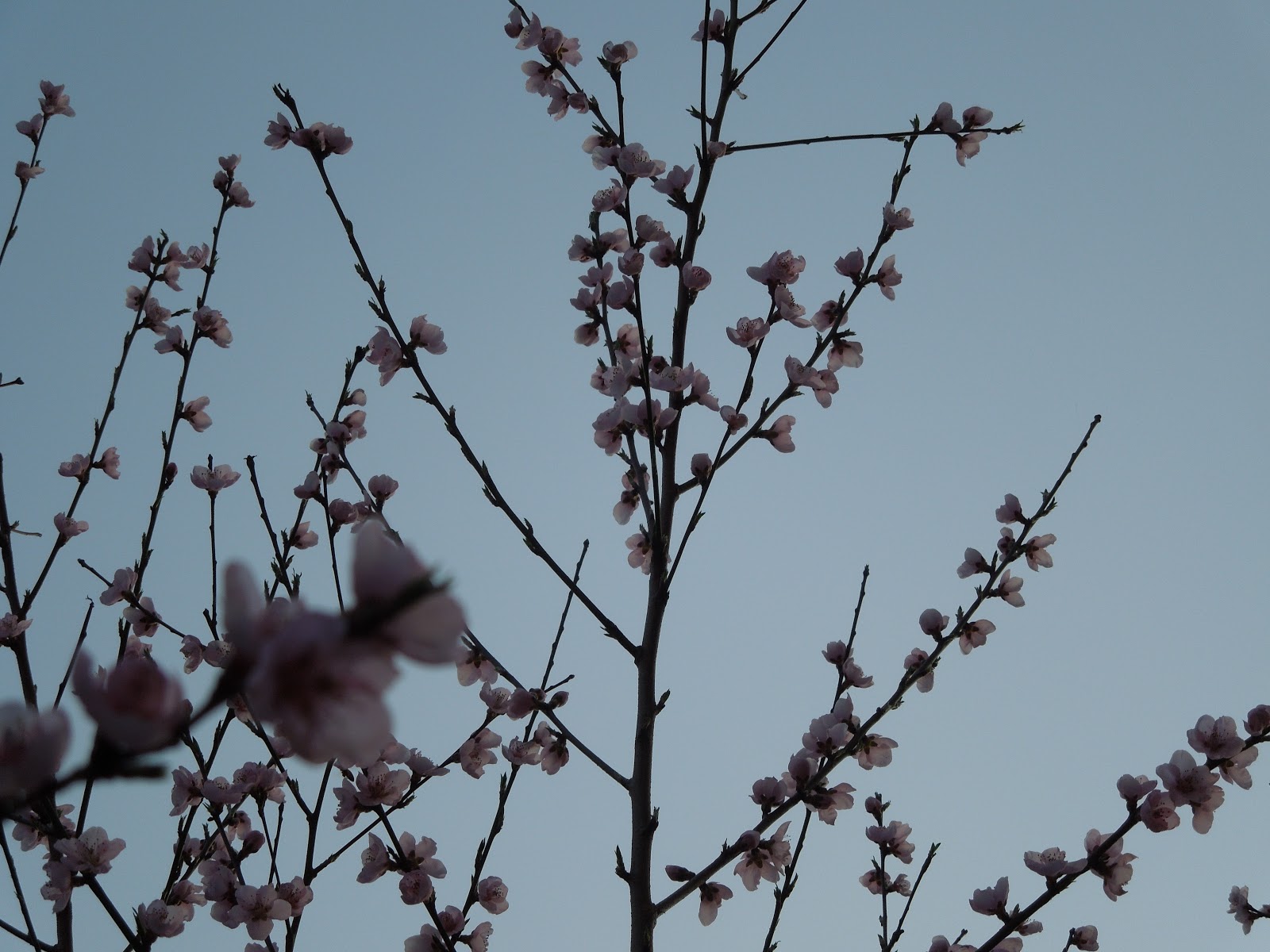
Pears, and the stone fruits-Plums, Cherries, Peaches-March/beginning of April


Yellow mustard-April


Crab Apples and Hawthornes-beginning of April


Apples-April

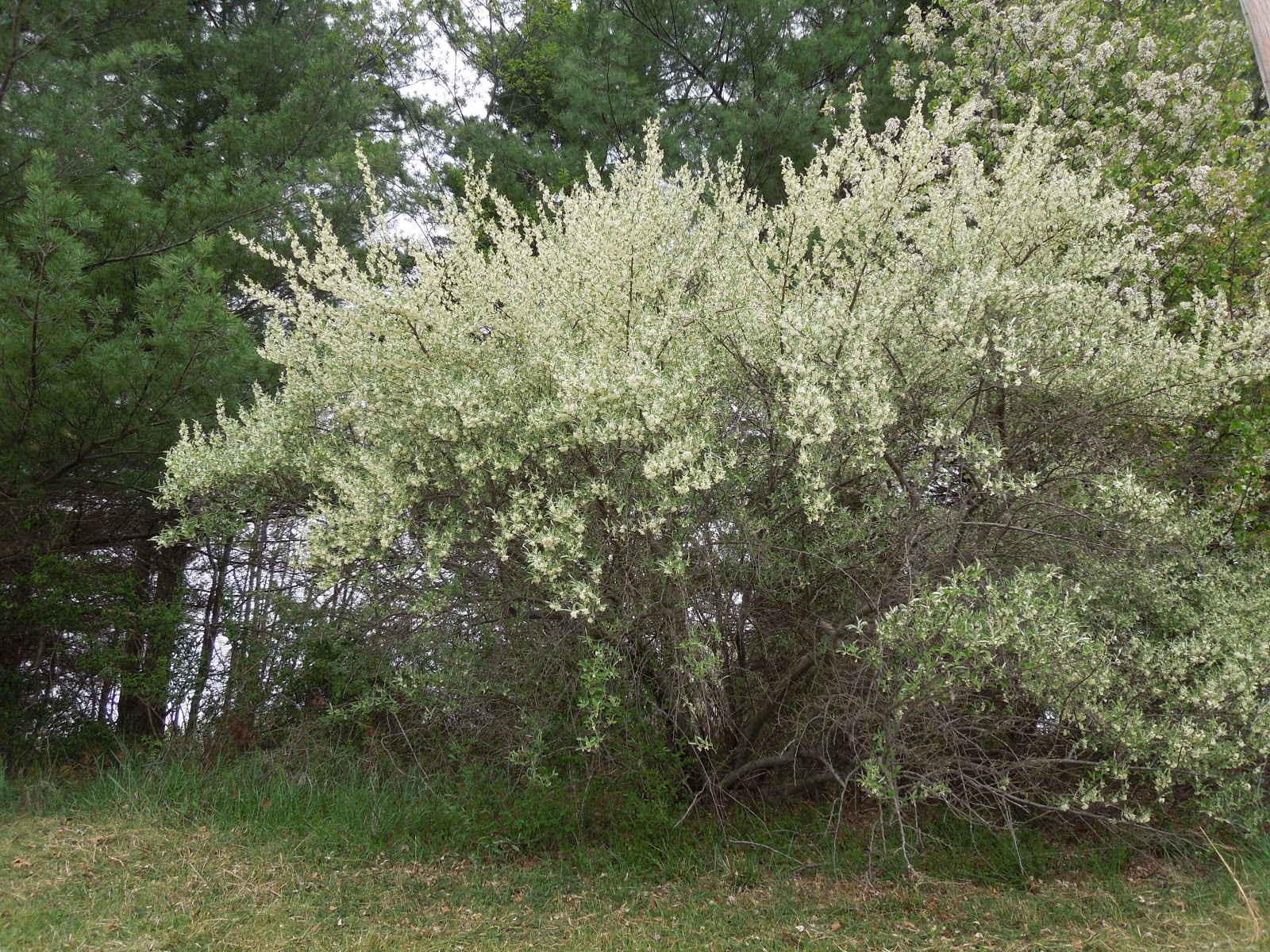
Autumn Olive and Holly bushes-end of April/May


And, a drum roll please.........the flowers we beekeepers live for around here! Because these have the nectar that makes the best tasting honey in the mid-Atlantic (in my and my customer's) opinions!

Honey and Black Locust trees-May and early June 

These trees grow wild on river banks and forest edges here.  But, they are increasingly domesticated and grow in perimeter landscaping of new town homes.  They are fast growing trees and attractive.  The blossoms hang down in clusters like white grapes.  They are very fragrant, and are likely the "fresh clean flower" scent you associate with spring.  If you look high in the trees where the sun hits first, you will see more developed flowers than down low below.  So, you see an opening progression from top to bottom of the tree.  And, with this comes the various bee and wasp visitors.  The locusts now blooming in my neighborhood are full of bumble bees, carpenter bees, honey bees, mason bees, sweat bees, leaf cutter bees, and paper wasps of several species.  They are all buzzing happily within the flowers and non-chalantly "bumping" into one another.  In fact, they are somewhat drunk with their happy finds.  I was able to gently rub the abdomen of a very contented bumble bee.  She was so intoxicated, she could not move or did not notice.

Locust honey makes for a very light in color, almost white or clear honey.  It has a lighter taste than the more familiar store bought clover varietals.  My customers love to put it in their morning teas and coffees.  It also thus demands a higher price than clover!  So, beekeepers, get those honey supers on your hives! The nectar flow is on and honey is in the making!  And, it's the good stuff!

Other flowers soon to bloom that also contribute to the ongoing nectar flow through June here:

Roses (and related Rosacea-Wild Blackberries, Wild Raspberries)-May/June
Wild and Domesticated Strawberries-May/June
Clover/Lavendar-May-July
Other wildflowers-summer months-Torch lilies, Coneflowers, etc.

Break in nectar flow in July and August-normally a hot drought month

Fall nectar flow-Asters and Goldenrod-September until the first frost in October or November.


The following are not considered significant bee flowers:

Pansies, Daffodils, Violets, Tulips, Forsythia, Forget me nots, Magnolias, Bleeding hearts, Lily of the valleys, Dogwoods, Redbuds, Lilacs, Irises
Daffodils
Violets
Dogwoods
Forsythia
Tulips
Redbuds


Special Cases:
Rhododendrons and Azaleas-more on these interesting flowers to come in a future post.


Friday, May 3, 2013

Bee Waggle Dancing

Two Sunday nights ago, I got a panicked text from my godaughter Ashley who lives nearby.  "Ant Kathy, help!" ("Ant" is how I'm referenced by relatives/godchildren of the next generation; it's a slang Southern corruption of "Aunt" for an aunt who happens to be an entomologist and beekeeper, thus "Ant").

Anyway,  Ashley proclaimed in texted abbreviated language that she had to do a freshman highschool science project that involved serious research.  Help! What to do?!  Could I assist?  (She stressed that I was not to do the project, but to provide ideas for her to do it.)  This is a trial project, although graded, for next year's real science fair project for the county.  It was to introduce her and her classmates to the steps involved in scientific research; such as the creation of a hypothesis, design methods for testing such, the testing and observation process and materials involved to collect the data points, and the summarizing and synthesizing of the collected data to draw general conclusions from the experimental study to then accept or throw out the hypothesis. 

"When is this project due, Ashley?" I return texted.  "Next Monday," came the answer.  "Oh," I texted back; (fortunately emotion is not obvious in texts)! "How long have you known about this?" my reply. "All semester," she typed.  "Oh," I offered. "Science projects generally cannot be done in one day or even one week.  They typically require replicated testings over a period of time. But, tell me about what you want to test."  (I tried to avoid any judgement from my post-Ph.D. frame of mind, and recall that I, too, would have (and in fact did wait) until the last minute in highschool.  It is such a busy time in one's life.  Hard not to!  And, in fact, this is part of the learning process.  Besides, this does not need to be publishable, it's a high school project for goodness sake, take a deep breath and relax, Doctor Kathy!

"I want to measure something with pollination and flowers and your bees." "Ok.  So, can you come to my house after work a couple of times this week to watch the bees and their behavior around the flowers?"  "Well, no, I have tennis practice every evening."  "Oh. OK. Can you come Saturday to sit by the hives most of the day?"  "Yes, if I can get a ride, but mom is working and my grandparents are going to a wedding."  "OK.  Well, why don't I pick you up Friday night and you spend the night with me and then we will start early Saturday morning with collecting data."  "AWESOME!!!!" came the texted reply.  (Who talks on phones anymore, anyway?! So, yesterday's news!)  "Oh, and I need a total of ten references, five of them by Wednesday."  "Ok." I gave her three and had her use those to research the others on her own. 

I started looking through my own resources, and pulled out my BeeCulture magazines from the last year.  The most recent one had a nice pictogram of the bee's waggle dance; the last century animal behavior Austrian scientist Karl von Frisch discovered this phenomenon.  It's quite amazing really.

A scout bee returning from a flower will communicate to her sisters where the flowers are located based upon the angle of the sun and it's relationship to the hive.  (In other words, the bees, with only a small neuroganglion for a brain, are doing sophisticated trigonometry to locate food resources and to recruit fellow foragers to go there and then return to the hive.)  The returning worker scout will waggle her abdomen on the frame in the hive; the angular degree to which she waggles from the center line of her body is the same angle as what the sun to the hive is in relation to the flowers at that moment.  Go figure! Literally!  "Ashley has to use this pictogram in her study!," I thought.


So over the next few days we texted and emailed and discussed possible questions she could ask.  We landed on counting resource (nectar/pollen) foraging flights to and from the hive as temperature changed or sun rose (ie. time of day).

Her research question (or null Hypothesis) became: Does temperature affect the number of foraging flights made by honeybee workers from a hive?

She came out Friday night and we got up early Saturday morning.  She sat by the hive from 7 am until 2pm.  I brought her water and food.


Over the course of the day, Ashley saw that temperature does indeed affect the number of foraging flights made by honeybee workers from a hive. At 7am and a temperature of 42F,  no one was flying. The first flight occurred at 8:47 am when the sun was higher and the temperature was 52F.   After the temperature reached this level and continued to climb (as did the sun), the number of foraging flights were seen the entire research period and correlated directly with the rise in temperature. In addition, more bees were seen returning to the hive with the rise in temperature. She observed them bringing in pollen of different colors. Bright red, yellow and orange were all represented.

For her project, she plans to summarize this information and discuss the waggle dance recruitment of workers.


Wednesday, May 1, 2013

European Union bans 3 pesticides that may affect bees

This is my reposting of Kim Flottum's article this week.

CATCH THE BUZZ
EU Votes To Ban Neonics, but Barely
Alan Harman
 
 A deeply divided European Union will go ahead with a ban on the use of three neonicotinoid insecticides – clothianidin, imidacloprid and thiamethoxam (sic) – blamed by critics for the decline in honey bee numbers (sic).
   The EU Commission will proceed with the suspension of their use from next Dec, 1 after 15 EU countries supported the restriction, eight voted against and 4 abstained.
   The halt will be for at least two years.
   “Although a majority of Member States now supports our proposal, the necessary qualified majority was not reached,” Health and Consumer Commissioner Tonio Borg said in a statement. “The decision now lies with the Commission. Since our proposal is based on a number of risks to bee health identified by the European Food Safety Authority, the Commission will go ahead with its text in the coming weeks.
   “I pledge to do my utmost to ensure that our bees, which are so vital to our ecosystem and contribute over €22 billion (US$28.8 billion) annually to European agriculture, are protected.”
    The plan restricts the use of the three neonicotinoids for seed treatment, soil application (granules) and foliar treatment on bee attractive plants and flowering crops such as corn, oil seed rape and sunflower.
   Any other authorized uses must be carried out by professionals.
   Exceptions will be limited to treating bee-attractive crops in greenhouses, in open-air fields only after flowering.
  An EU statement says that as soon as new information is available, and at the latest within two years, the Commission will review the conditions of approval of the three neonicotinoids to take into account relevant scientific and technical developments.
   Experts representing the 27 EU countries had met March 15 as the Standing Committee on the Food Chain and Animal Health and failed to reach a qualified majority to on the proposal to ban the three neonicotinoids.
   Then the vote was 13 for a ban, nine against with five abstentions. The proposal was then referred to the appeal committee which also failed to reach the required majority, allowing the Commission to step in and impose the two-year ban.
   The decision is seen as a victory for campaigners concerned about dramatic declines in bees, but a defeat for the chemical companies who make the products and the UK government which said a ban will harm food production.
   The UK’s Soil Association Head of Policy Emma Hockridge called the decision a victory not only for the bees and other pollinators, but for independent science against the political, pro-pesticide position adopted by UK Environment Secretary Owen Paterson and the pesticide industry.
  “There is strong evidence that a ban on neonicotinoids would work,” Hockridge says. “In Italy, where the government has taken decisive action and banned certain neonicotinoids pesticides, deaths of honey bees in winter subsequently fell by more than 50% in three years.”


Subscribe to Malcolm Sanford’s Apis Newsletter right here for a comprehensive listing of beekeeping events around the country and around the globe, check out Bee Culture’s Global Beekeeping Calendar
Quality Top Bar Hive by Gold Star Honeybees - good for you, good for your bees, good for the planet. Check us out at www.goldstarhoneybees.com.
This message brought to you by Bee Culture, The Magazine Of American Beekeeping, published by the A.I. Root Company.
 Free practical insights, helpful information, and fun from Award Winning Kelley Bees's monthly newsletter.
Need more bees?  Need better bees?  Feed Global Patties for better bee health, production, wintering and survival.  Hungry hives will often eat a patty a week -- even when pollen is available in the field. Try Global Patties and see the difference. Learn More.
Small Hive Beetle traps and control products, Worlds largest selection, all chemical free.  www.beetlejail.com
Little Bee Books at www.littlebeebooks.com.  by RewardsArcade Suite" href=""Take a look today.

Monday, April 22, 2013

The basics: birds and bees or bees on the dole?!


Before there is a nectar flow going in this mid-Atlantic area in the early spring months, the bees are hard-pressed to find enough nectar to eat and store and make into honey.  These early blossoming flowers are more about producing pollen (the male sexual gamete, ie. sperm, of the flower), which the bees place in their pollen sacs and take back to the hive and store for nutrition and development of the brood. So, although they are getting pollen, (if a freeze has not killed the flowers) you must feed them sugar syrup that you make to keep the hive going until the nectar flow is in full force.

In my area of Western Maryland, the pollen sources arrive early and before nectar -first as flowering maples, then crocus and dandelions; then wild yellow mustard; this occurs typically from January’s end through Marches’ beginning; (we were late this year, and so we seem to have adjusted everything by about a month in occurrence).  The stone fruit trees, like plums, cherries, and peaches, as well as pears follow and are flowering now in mid-April; they provide some nectar for the bees, but also pollen.  Crab apple and Hawthorne blossoms will be next to follow.  The apples follow these; and then the Autumn olives after that by April's end; locusts, roses, wild blackberries and raspberries will open in May through June, and finally the summer clover will be in full force from the end of May through most of July.  

This flower parade represents the normal progression of blooms and food resources for my girls in this area.  It all of course totally depends upon the temperature and the rainfall.  A drought and heat wave will inhibit a nectar flow, just as a freeze and severe cold will. 

The definition of nectar is - A sugary fluid secreted by plants, esp. within flowers to encourage pollination by insects and collected by bees to make honey. Nectar is an ecologically important item, the sugar source for honey; nectar secretion increases as the flower is visited by pollinators. After pollination, the nectar is frequently reabsorbed into the plant. The main ingredient of nectar is natural sugar (i.e., sucrose (table sugar), glucose, and fructose).
So, nectar is a sugar-water mixture that the flower makes; the amount of water in the nectar depends upon the blossom.  Different flowers have evolved different-sized nectaries, and nectary / pollen stalk (or anther) arrangements.  Nectaries are the "bars", the places where the bee or bird or moth sticks its mouthparts or beak to sip upon the drink.  Many flowers have evolved to have deep nectaries with large volumes of tasty nectar, and bees, butterflies, moths, or hummingbirds will spend lots of time on these. 

Some flowers have developed “landing pads" (petals) and brilliantly colored flowers and symbols or designs that point to where the nectary is for the animal or insect to hone in to this nectary for a sip.  Certain flower colors attract more than others.  Bees are fond of blues, purples, and similar variations toward the uv (ultra violet) spectrum of light. 

Why would flowers evolve such a display for the bees?  Well,  basically it’s all about sex.  The plant wants to reproduce, the flower is the mating organ for this to happen.  The nectar is a reward for the bee, as it picks up the male flower’s sperm-the pollen on its anthers, and delivers it to another flower’s female part, the stigma (that has the sticky nectar), to trap the grains of pollen. 

Some flowers are wind pollinated, some bird or bat or small mammal/rodent pollinated; but many are bee pollinated.  Some crops are exclusively pollinated by honeybees, for instance the almonds of the San Joaquin Valley in California MUST be pollinated by honeybees!  And, big bucks are involved with commercial beekeepers trucking their bees out to California for this purpose.

A true nectar flow will begin with the apple blossoms appearing here in my area and going through the summer months with the clover blossoms.  The clover will dry up by the end of July and the nectar flow will be over until the fall flowers (goldenrod and asters mostly) begin to blossom in September; again, this is dependent upon rainfall and temperatures; a fall nectar flow may go through November at times.  (But, I do not harvest honey in the fall, as the bees must have at least 60 pounds of stored honey in their hives to get through the winter months in the mid-Atlantic.)

I digress. Back to the spring nectar flow where we now find ourselves...Once the apple flowers are open, feeding your bees sugar water "synthesized nectar" will no longer be needed.  Most beekeepers keep calendars of flowering blooms in and around their beeyard areas, and of course, they try to plant for flowers the bees will visit and use.

The bees will tell you when they are thirsty or not for feeding them.  I put my hivetop feeders on with their floating wooden slats that ride up or down inside with the volume of the sugar syrup.  The bees need these floats to stand on while drinking the sugar water, or else they will drown in their attempt to get a nectar sip.  (Their wings become coated with sugar water and they can’t fly, or they cover their spiracles-paired breathing tubes on either side of their abdomen-and suffocate.)

It will be obvious when the bees are hungry and you should feed.  The minute they get a whiff of the sugar syrup, they line up like little piggies at a trough and start drinking. They shove and displace one another just like little piggies at a trough or at a nursing sow!

Each time you open the hive to check the volume of feed remaining, you will see it diminished if they are hungry, or not, if they are getting enough wild flower nectar from flowers in the yard.  If they are no longer taking the feed, you may (and should) take the feeders off of the hive.  If you do not take the feeders off, you will develop what I call social welfare bees; yes, bees on the dole! 

You need to practice tough love parenting at this time!  Your girls will say, “Why should we leave the hive and work for flower nectar when this pretty good stuff is right here in front of us in the hive?!”  Kick them out!  Or, they will actually become lazy.  Lazy bees are a sad sight, and do nothing to promote the old addage of busy as bees!

You think I jest! One year I had a hive that wanted to just drink sugar syrup.  There was a nectar flow, but they only drank the syrup in the feeder.  I realized, it was time to make them leave the hive and work for a living, as 50 lb bags of sugar at Cosco are rather expensive!  (They are also rather heavy to lift and it takes time to mix the syrup!)  So, I kicked the girls out by removing the feeders; they soon got the message.  Work or else!  This is a commune, not a welfare state!


Why do beekeepers feed their honeybees?
1) To stimulate the queen to lay as many eggs as she can in the spring months.
2) To build up honey reserves for the winter in late summer (August) and early fall months; (a hive must have at least 60 lbs of honey stored to make it through the winter in the mid-Atlantic of the US.)
3) To complete successful overwintering in the late winter / early spring months.

What do beekeepers feed their bees?
Sugar syrup
1:1 sugar to water syrup (in spring)
2:1 sugar to water syrup (in fall)
Fondant a thick solid almost cake icing mixture (winter and early spring)
Pollen substitute patties when pollen is scarce (late winter and early spring)

Never use high fructose corn syrup.  Mix your own sugar syrup.  As I say above, I buy 50 lb bags of granulated sugar at Cosco.  In the checkout line people always ask me if I'm a baker....I tell them, "No, I just have a sweet tooth."  It works, as I shop in West Virginia!
 
This time of year use 1:1.  (In the late summer and early fall use 2:1 to prep to store feed for the winter months.)  I mix up 1:1 sugar to water syrup.  I add a pinch of cream of tartar to help ease of change from "nectar" to honey, and I also add a tablespoon of apple cider vinegar (not white distilled).  The vinegar cuts down on mold growth in the feeders.  Although, when the girls are thirsty and standing at the feeder sides and slurping it all up, it seems vinegar is not really needed.  

At this point, unlike earlier feedings during installation (see previous blog post), I do not add the antibiotic Fumigilin B to the feed syrup.  I see no more signs of dysentery or distress in the hive. Everyone seems pretty happy.  They are in fact busy as bees!


Wednesday, April 10, 2013

Cherries delight; it's a bee safari!

It's spring!,... at long last.  We have now had four above 70 degree F days and my girls are loving it!  Actually, the humans are, too.  Convertibles and shortsleeves abound.  This is a good day to peak inside the hives. But, first, I see the girls making beelines to and from the cherry trees and other various flower sources in my yard and back to their hives.


A closer walk by the  cherry tree blossoms reveals both a lovely fragrance and the fact that my girls are not alone.  My front yard cherry tree has become a veritable entomological safari for a hymenopterist (someone who studies bees, wasps and ants).  The tree is literally buzzing with tiny sweat bees, several kinds of bumble bees, mason bees, leaf cutter bees, paper wasps of two types, and carpenter bees all happily buzzing within the blooms.  They don't even notice me.  (As a beekeeper and an entomologists, I keep track of all the native pollinators as well as my honeybees, and I try and encourage their existence.)


Mason bees are actually the super pollinator workers of this region.  They are not a social bee.  They live singly in holes, but as a group.  They work a longer day than honeybees (up before sunrise and down after sunset) and pollinate lots more than any other native bee.  They look something like a honeybee, but are less yellow and smaller.  One can buy a mason bee house (a collection of bamboo cross sections) and hang it on a Southeastern wall to encourage them.  Soon the bees will find it.  It is extremely active today.


I walk to the backyard and see that various bees and wasps are also on the peach blossoms that have opened.  It too seems popular with the bumblebees and wasps as well as my girls.


I crank up the smoker.  Smoke is used to calm the bees.  Although very little smoke is needed on a day like today.  Sunny, and most workers are out and happy; stings are unlikely.
The smoke makes the bees think their hive is on fire and they engorge themselves with honey in case they must take off and make a new hive somewhere.  This seems a little cruel to me.  But, it does benefit me in the long run.  Their distended little abdomens are then in no shape (literally) to sting! So I can work as long as I need. A puff is all they need.  You don't want to give them emphysema!

I crack open the lid, and the sound is a lowered pitch and happy humming noise this time!  In tune with the happy spring day and universe.  Yes!  This is a good sign.  Everyone who is able to fly is out and about checking out all the recent blooms that have seemingly opened overnight.  I move some frames and see what I've been waiting eagerly to see; there are capped egg cells.  They are gorgeous.  They look just like a perfect tan pie crust grandma used to make!  Someone has been laying eggs!  There are also eggs in open cells and various stage C-shaped larvae in others.  The hive is increasing in numbers.  Hooray!  And, there she is!  She's beautiful.  The queen is alive! I rejoice in my own little Easter event!  The old beekeeper was right!


.

Monday, April 8, 2013

Wise old beekeepers are worth their salt!...The beewhisperer responds.

I like to think I know what insects are doing after about 23 years of spending a career as a Ph.D. Entomologist.  True, I’ve been beekeeping now for only about 7 of those 23 years, but I’ve worked with social insects (ants, termites, bees and wasps of all sorts) in a variety of settings, and I like to at least think I can anticipate their behavior. 

What always interests me is how the insects throw you a curve ball sometimes, and do not read the books or literature; it keeps it very interesting.  I learn something new every season.  And, it’s never ever dull. 

(This is also a reason to keep two hives and not one if you are new to beekeeping.  Each hive will have its own separate personality - dependent on the queen - and can be very different from the other.  And, then there is the matter of potentially losing a queen and the whole hive collapsing as a result.  Good to have a back-up!)

When I’m truly stumped, I go to someone with more experience than I.  For beekeeping, that is usually an older beekeeper who has done this for about 40-50 years!  This guy never wears gloves or a beesuit; he does use a veil and smoke, but he seldom gets stung at any time of the year or season!  I’ve personally nicknamed him the “beewhisperer.”  When he does happen to get stung, he’s grateful, in that bee stings (if you are not in that 1% of the population that has anaphylactic reactions) mount a wonderful  immune response that is known to assist with a host of ailments, including: arthritis, MS and other diseases; they are even thought to help prevent cancer.  (A future blog will have to address the medical benefits of the hive, from honey and pollen to stings!)

So, since I’ve been concerned about what would happen in my hive with this really bizarre cold weather we have had, I called the guy.

Rule no. 1 in beekeeping: Know your limitations!  Never be unwilling or afraid to ask for help!  There are no dumb questions.  All beekeepers are generally eager to share their advice and experience. 

I explained the situation to him.  In a nutshell (both for review and for those of you who have sped read the blog to date…), I installed the hive package and queen on Saturday, March 23rd.  (The bees installed were from Georgia; but, I live in Western Maryland; these Southern belle bees were no doubt shocked.)  On Monday, March 25th, we had had a late season and very unusual snowstorm.  Temperatures dropped into the low 20F’s at night and got up to only the upper 30F’s during the day. There was also a vicious North wind blowing about 10-25 mph.  This weather lingered for a week.  On the following Saturday March 30th, I opened the hive to discover the queen was out of her queen cage, but I saw no sign of her.  There was also no evidence of her presence such as eggs or larvae (called brood). 

What to my horror I’d seen instead, were 4-5 supersedure queen cells!  These are emergency queen cells and typically only made when the queen has died or is on her way out.  I assumed the worse.  Now you, the reader, are caught up. 

Thus, my call to the wise old beekeeper.  I asked him, “do I need to buy a new queen immediately and have her shipped overnight?  Or do you think the supersedure cells will emerge ok and a new queen be developed? Or should I combine this now weakened hive with the healthy stronger hive that does have a queen who emerged.”

(I have on purpose failed to mention that fellow beekeeper Trevor’s hive has a queen!  I’ve not mentioned this mostly because I’m very competitive and was so appalled and embarassed that mine would die and that his would survive;  I’ve been doing this for 7 years and he is a brand new beekeeper!   Ok. I admit it! I was really bummed! He of course was convinced his superior beekeeping skill and recent classroom learning  
experience made for his success.  “I have to let go of this”, I kept telling myself; there really is no room for competition in beekeeping, and besides I want his girls to survive.  He told me he’d share.  But, the prospect of his hive surviving and mine dying and his hive being there all summer long in my yard staring me in the face as a constant reminder, was well, more than I could stand.  It really stuck in my craw.  "I suppose I’m learning something from this," I thought. "Let it go.")

“Hmmm”, the old beekeeper said with his drawl and brought me back to my senses-he hails from Georgia himself, and I could just picture him scratching his beard.  "Well, it’s hard to say precisely, but I’ll bet you she’s still in there and is ok."  “Really?”, I asked incredulously. 

“You say you got her from Georgia?” “ Yes sir,” I replied. “ Well, there’s been times I’ve seen it where they are disturbed or upset and just make supersedure cells to make supersedure cells," he said, with some authority provided by experience.  “Even if the queen is ok,” I asked?  "Well, yes, they are from Georgia, and you’ve put them in a snow storm and cold weather in Maryland, and they’re just perturbed and upset," he said. 

“Perturbed and upset,” I echoed into the receiver.

“So, I’d say the queen left the queen cage successfully, and laid a few eggs before the temperature fell.  The workers have fed those larvae royal jelly and they are now pupating as presumptive emergency queens on the ready.  The problem is that they wouldn’t be ready in time to save the hive likely if your queen really is gone.  Once they emerge, they need about 12-14 days to become reproductively competent and take their mating flight.  The problem is that there are no drones out there to mate with.  It’s been too cold.  You’d need to order a new queen to save the hive.  You could combine it with the other good hive, but I have 100 queens on order ready for purchase this next week.  Why not check your hive this weekend, when the weather is good, and tell me what you find.  But, again, I’d not be surprised if she’s in there!”

“Oh, thank you so much, sir!,” I hung up in a much happier frame of mind.  And, suddenly, I just had a good feeling he’d be right and all would be well with my hive after all.

Now, my interest is really picqued!  Do you suppose she has survived and is really in there?  It’s too cold to find out today! I can’t wait for a warm day (hopefully tomorrow?) to see.